Blog
Insights
The Interface Is Disappearing: Software Built Around Intent
We once learned how software wanted to work. The next generation of interfaces may learn what we are trying to accomplish.

Diana Mounter
Human Resources
Every piece of software teaches its users a small language.
To edit a photograph, manage a project, prepare a report, or book a trip, we learn where the menus are, which buttons matter, and what sequence of steps the system expects.
Good design makes that language easier to understand. Yet the underlying arrangement has remained remarkably consistent: people adapt their intentions to the structure of the software.
A different model is beginning to emerge.
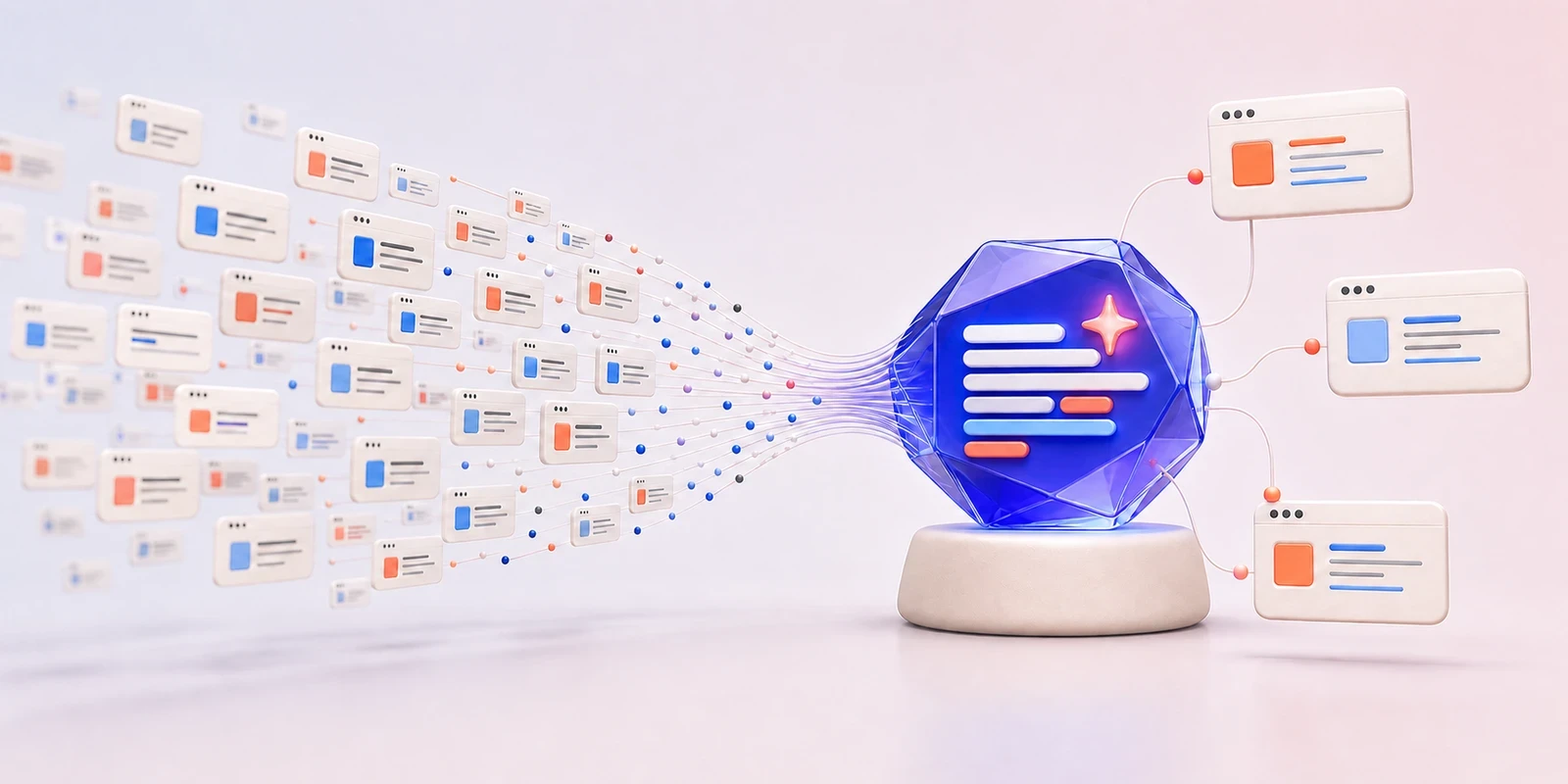
Instead of asking users to locate every command, software can interpret the outcome they want and assemble the appropriate tools around that intention.
The interface does not disappear completely. It becomes fluid.
From Commands to Outcomes
Traditional software requires procedural knowledge.
A user must know not only what they want, but how the application represents it. They translate their goal into a series of clicks, fields, filters, and commands.
Intent-driven software begins with the goal itself.
A business owner might say:
“Show me which products lost repeat customers this quarter and suggest three questions we should investigate.”
A designer might request:
“Adapt this layout for mobile while preserving the hierarchy and spacing rhythm.”
A traveler might ask:
“Find a quiet three-day trip reachable by train, avoiding destinations with heavy rain.”
The software must then identify which information, tools, and decisions are required to help accomplish that outcome.
The Interface Becomes Adaptive
This does not necessarily mean replacing every screen with an empty chat box.
Conversation is useful for expressing ambiguous goals, but visual controls remain better for comparison, precision, monitoring, and confirmation.
The more interesting future combines the two.
An adaptive system might receive a request conversationally and then construct a temporary interface containing:
The information relevant to the request.
Controls for the decisions that require human input.
A preview of the proposed result.
Explanations of assumptions.
Alternatives the user can compare.
A clear confirmation before consequential action.
Instead of navigating through the complete application, the user receives a focused workspace built around the present task.
Why Fixed Interfaces Will Remain
Predictability has value.
People learn familiar interfaces and become efficient with them. A button that moves every time software guesses the user’s intent would quickly become frustrating. Important controls must remain visible, stable, and understandable.
The future is therefore unlikely to be completely generated at every moment.
A stronger model combines a dependable foundation with an adaptive layer:
Stable navigation for orientation.
Consistent controls for important actions.
Flexible workspaces for complex goals.
Conversation for ambiguity.
Visual previews for verification.
History for understanding what changed.
The interface can adapt without becoming unpredictable.
“The best interface may not be the one with the fewest controls. It may be the one that presents the right controls at the right moment.”
Innovation Requires Restraint
An interface that can transform itself is impressive. That does not automatically make it useful.
Adaptive software must avoid several common failures.
Excessive assumption
The system should not silently decide what a person meant when the consequences matter. It should expose uncertainty and ask for confirmation when necessary.
Invisible action
Users need to understand what the software is doing on their behalf. Progress, sources, changes, and failures should remain observable.
Interface instability
Frequently used actions should not move unpredictably. Adaptation should reduce effort without forcing users to relearn the product during every session.
Automation without recovery
Every meaningful action should have an understandable stopping point, preview, or method of reversal.
These principles are not limitations on innovation. They are what make innovation dependable enough to use.
Designing Around Human Intent
Intent-driven products require designers to think beyond individual screens.
They must understand the complete relationship between:
What the user says.
What the user actually needs.
What context the system possesses.
Which tools are available.
Which decisions should remain human.
How results should be verified.
This changes the designer’s role.
Instead of defining only what an interface looks like, designers increasingly define how the system behaves when the request is incomplete, contradictory, or uncertain.
The most important design work may happen between screens.
Software That Meets Us Halfway
For years, becoming “good with computers” meant learning how machines organized information.
Intent-driven systems offer a more balanced relationship. People explain their goals in familiar language, and software translates those goals into structured operations.
Research systems such as Magentic-UI are already exploring human involvement in complex, multi-step agent workflows. Other work is investigating how natural-language intentions can be converted into interfaces assembled from controlled components rather than unrestricted generated layouts.
The direction is promising, even though the design conventions are still developing.
Conclusion
The interface of the future will not necessarily vanish. It will become more responsive to purpose.
Menus, forms, and dashboards will continue to exist wherever consistency and precision matter. Around them, adaptive layers will help people express goals, explore possibilities, and coordinate complex work without manually directing every step.
The measure of a good product will shift.
We will ask not only, “Is this interface easy to use?”
We will also ask, “How quickly did the software understand what I was trying to accomplish—and how confidently could I remain in control?”
That is the deeper promise of intent-driven computing: software that does not merely wait for instructions, but helps shape a clear path from an idea to an outcome.
Further reading
The Magentic-UI research project explores human involvement in agent-driven, multi-step computer tasks. Research on interfaces generated from natural-language specifications examines how adaptive layouts can remain bounded by vetted components and deterministic rendering.
Diana Mounter
Human Resources
Share